
The main difference between quick-drain and high-pressure casting is not simply the pressure level.
It is the combination of dewatering force, mould material and process controllability.
Low-pressure quick-drain casting mainly relies on slurry head pressure and the capillary absorption of a gypsum mould.
It is relatively simple, flexible and economical.
High-pressure casting applies a programmable pressure curve through a porous resin mould, making wall thickness, body density and cycle time easier to standardize.
In sanitary ware manufacturing, “quick-drain” usually refers to low-pressure rapid-drainage casting with gypsum moulds. The slip enters the mould under low pressure, while the gypsum absorbs water and builds the ceramic wall. Excess slip is then drained.
A Chinese technical description of the process explains that low-pressure quick-drain casting uses slurry pressure from an elevated tank together with the capillary pores of the gypsum mould, rather than an external high-pressure system. (Low-Pressure Quick-Drain Process)
High-pressure casting uses dedicated equipment and porous resin moulds. Mechanical pressure accelerates water removal, while the machine controls filling, pressure rise, holding, pressure release and demoulding.
A comparative study published by China Ceramic Industry examined the two processes in terms of mould structure, green-body performance and practical operating issues.
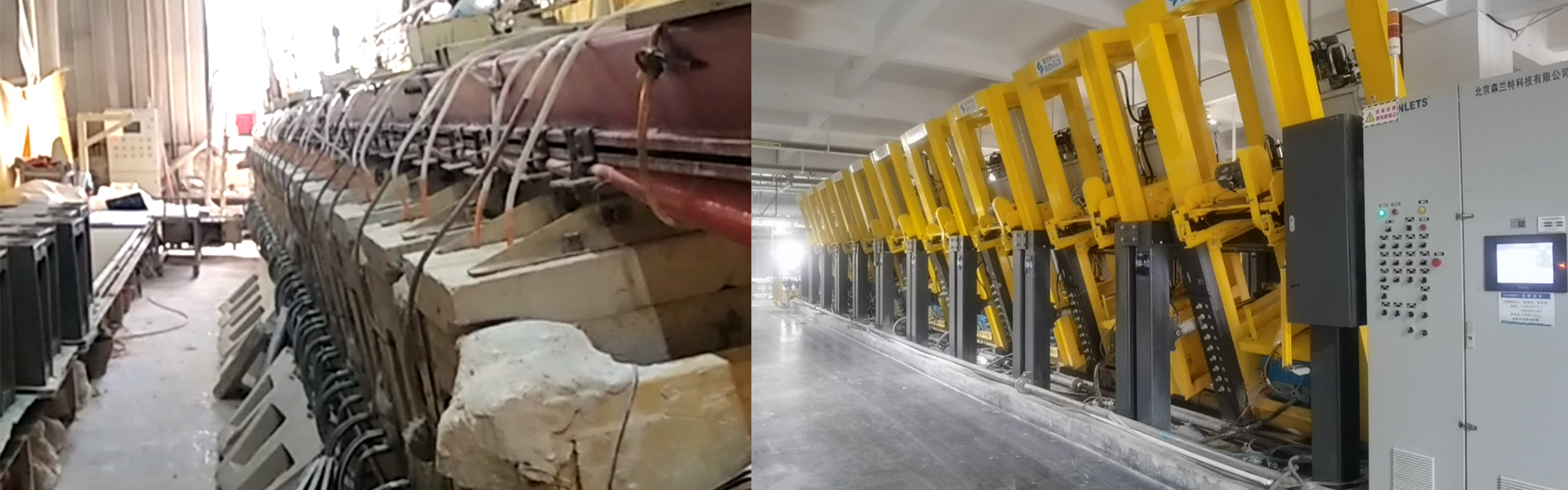
Parameter controllability is different. A quick-drain line can use PLC control for filling, drainage and timing. However, the actual casting rate still depends on gypsum porosity, mould moisture, temperature, drying recovery and previous cycles. Two moulds running the same timer may therefore produce different wall thicknesses. High-pressure casting allows a programmed cycle for filling, pressure build-up, holding, pressure release and release assistance. Modern systems can measure the thickness of the body leaving the casting cycle and use feedback to adjust casting time when slip rheology changes. |  |
integrated integrated high-pressure system, for example, measures product thickness after casting and uses feedback to optimize the cycle in response to small rheological changes.
Green-body consistency is different. In quick-drain casting, wall thickness and release strength are more sensitive to mould condition and shop-floor rhythm. The process can still produce high-quality sanitary ware, but it requires disciplined control of slip properties, mould drying and operating time.
High-pressure casting uses stable mechanical pressure and designed drainage paths in the resin mould. This makes it easier to control complex waterways, local wall thickness, green-body density and batch repeatability, especially for high-volume products.
The cost structure is different. Quick-drain systems normally require lower initial investment. Gypsum moulds are easier to manufacture or replace, and the process suits mixed models and frequent changeovers. The trade-off is greater dependence on mould drying, maintenance, labour discipline and supervision.
High-pressure systems require more expensive machinery, resin moulds and technical development. In return, they can provide higher mould utilization, greater automation and stronger repeatability. Industry practice similarly describes traditional plaster-mould casting as straightforward, economical and flexible, while its high-pressure range uses purpose-built machinery and resin mould technology.
For multiple models, small-to-medium batches and frequent changeovers, evaluate quick-drain casting first.
For complex geometries, high-volume orders and strict dimensional requirements, evaluate high-pressure casting first.
Compare mould life, labour, energy, cycle time, maintenance and yield—not equipment price alone.
Test the actual product and production slip before selecting the investment route.
Sunlets combines sanitary ware production with casting-equipment and mould development. This allows product geometry, order volume, quality targets and investment requirements to be evaluated before matching the forming solution.
Quick-drain casting is valued for maturity, flexibility and lower investment. High-pressure casting is valued for programmable control, automation and green-body consistency.
The correct decision is not which process appears more advanced. It is which process can repeatedly manufacture the required product, at the required quality and volume, with a controllable total cost.
Can quick-drain casting produce high-quality sanitary ware?
Yes. Quality can be high when slip condition, mould moisture, drying recovery and operating rhythm are tightly controlled.
Is high-pressure casting suitable for every order?
No. For low volumes or frequent product changes, the equipment and resin-mould investment may not provide the best return.