
Introduction: "Performance Aesthetics" Beyond the Surface
The value of premium sanitaryware lies not just in its glaze luster, but in its underlying functional logic. According to , functional failure is the leading cause of brand erosion. Sunlets utilizes a multi-dimensional verification model to eliminate performance risks long before a product reaches the consumer.
Fluid Dynamics Verification: Digital and Physical Flush Testing
For waste-removal products like toilets, flushing efficiency is the cornerstone of verification. Vacuum Stability Analysis: For siphonic toilets, precision pressure sensors monitor vacuum fluctuations during the flush cycle. Original Insight: We have observed that optimizing internal trapway smoothness—achieved by fine-tuning the Deflocculant ratio—can enhance peak siphonic stability by 12%. | 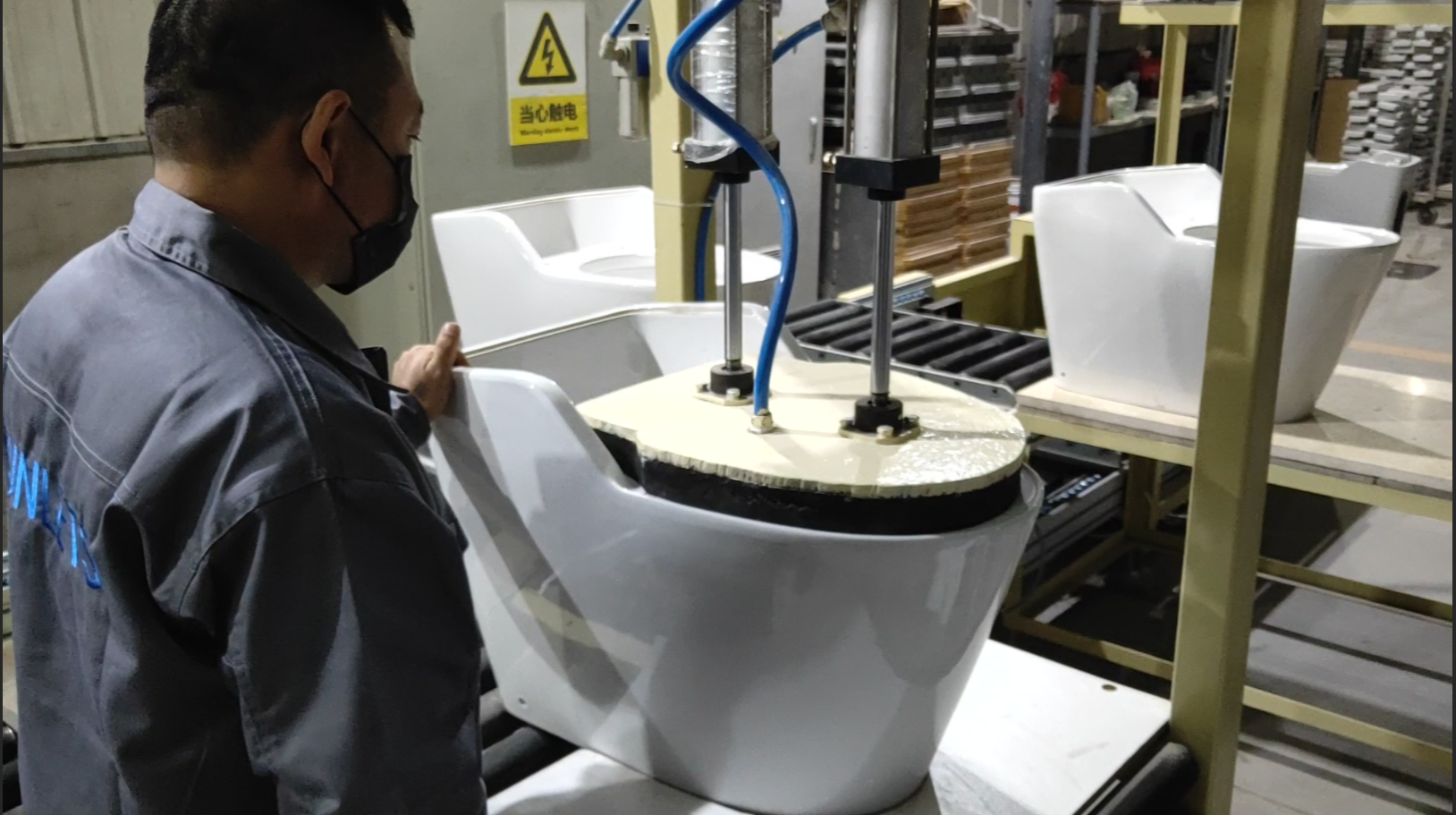 |
High-end ceramics must exhibit exceptional stain and corrosion resistance.
Contact Angle Testing: Goniometers measure the surface energy of the glaze. Premium easy-clean glazes are expected to maintain a contact angle above 90°, ensuring hydrophobic properties that facilitate self-cleaning.
Abrasion Cycle Testing: Simulating 20 years of scrubbing. Referencing , the change in Surface Roughness (Ra value) after 50,000 cycles is the primary metric for long-term durability.
Structural Reliability Verification: Stress and Load Limits
Thermal Shock Resistance: Samples are cycled between 15°C and 110°C. This evaluates the expansion coefficient matching between the glaze and the body skeleton, reinforced by Plasticizers.
Load Limit Testing: For wall-hung toilets and larg basins, we conduct static load tests exceeding 400kg to verify stress concentration at connection points and support brackets.