
Large ceramic products are more difficult to fire because wall-thickness variation causes different heating and shrinkage rates, while longer heat-transfer paths increase temperature differences between the surface and interior.
· Thin sections may begin sintering and shrinking while thick sections remain cooler.
· At higher temperatures, liquid-phase formation reduces the body’s resistance to deformation.
· When this behavior combines with greater self-weight, long unsupported spans and unsuitable kiln support, the risk of cracking, sagging, twisting and dimensional deviation increases.
Large ceramic product firing is the high-temperature processing of large basins, integrated washbasins, one-piece toilets, smart-toilet bodies, pedestal basins and other large-span sanitary ware products.
During firing, the body must complete gas release, mineral transformation, sintering and densification while maintaining its designed geometry.
Compared with standard products, large ceramic bodies generally have: Larger surfaces and unsupported spans; Longer internal heat-transfer paths; Greater wall-thickness variation; Higher self-weight; More complex cavities and mounting structures. | 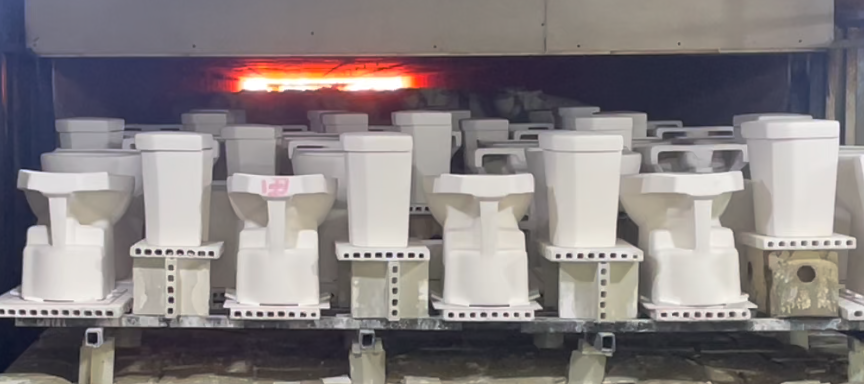 |
1. Wall-thickness variation creates different thermal responses
Thin sections heat and cool faster than thick sections. As a result, different regions may enter sintering and shrinkage at different times, generating tensile and compressive stress at connecting areas.
Research on temperature and stress gradients in large ceramic components shows that thermal gradients can produce differential shrinkage, distortion and potential cracking.
2. Larger dimensions amplify internal temperature differences
The larger the component, the longer heat takes to travel from the surface to the interior. A stable kiln reading does not guarantee that the center, thick sections and enclosed cavities have reached the same temperature.
If the heating rate is too aggressive, outer areas may react before the interior. During cooling, the surface may also contract earlier than the center, producing additional stress.
3. Self-weight increases high-temperature deformation
When a sanitary ware body develops a viscous glass phase during firing, its resistance to bending decreases. A study on pyroplastic deformation in sanitary ware porcelain bodies explains that firing distortion is influenced both by the flow of the high-temperature glassy phase and by stress from the product’s own weight. Because large products are heavier and have longer spans, unsuitable support can lead to sagging at the bottom, rims or mounting surfaces. |  |
4. Kiln temperature variation becomes dimensional variation
Large products occupy more kiln space and can interfere with normal heat and airflow distribution. Insufficient spacing, excessive loading density and inconsistent orientation may create local hot and cold zones.
Control wall thickness: Avoid abrupt transitions at bottoms, rims and joints.
Adjust heating rates: Allow sufficient equalization for thick sections and cavities.
Verify temperature differences: Use temperature rings or data loggers at multiple positions.
Optimize support: Design kiln furniture according to weight and deformation direction.
Control loading: Maintain suitable product spacing and airflow paths.
Track variation: Link kiln position with deformation, absorption and first-pass yield.
Conduct firing trials: Validate orientation, support and firing schedules for new products.
Large-product firing is risky not simply because the product is bigger, but because size amplifies wall-thickness differences, temperature gradients, self-weight and support errors. Wall thickness controls thermal response. Temperature uniformity controls synchronized shrinkage. Self-weight influences the direction of high-temperature deformation. Reliable production therefore requires product design, firing curves, kiln loading and support systems to be validated together.
Q1: Why are large ceramic products more likely to crack during firing?
A: Their internal temperature differences are larger, so thick and thin sections may heat and shrink at different rates, concentrating stress at connecting areas.
Q2: Can a longer firing cycle eliminate large-product deformation?
A: Not necessarily. Longer temperature equalization may reduce thermal gradients, but excessive high-temperature time can increase pyroplastic deformation.
Q3: What is the most important control point for large-product firing?
A: The priorities are stable wall thickness, low internal temperature gradients, correctly positioned supports and validation under actual kiln-loading conditions.