
Cutting workers may reduce payroll temporarily while increasing waiting, downtime, repair and scrap. A sanitary ware plant needs to reduce the labor, energy, material, maintenance and quality loss assigned to each qualified product. Automation should stabilize rhythm and yield, while efficient kilns should improve combustion, loading, insulation and heat recovery. Both need verification through cost per qualified product.
When staffing falls, material supply, inspection, changeover and exception response may slow. Forming variation can become extra finishing and inspection work, while insufficient maintenance extends downtime. If qualified output falls with payroll, unit cost can rise.
The stronger sequence is to identify repetitive handling, waiting and operator-dependent variation, remove ineffective work through standardization and automation, and then redesign job allocation. People should move from repetition toward process confirmation, maintenance, quality analysis and exception handling.
Automation can stabilize forming programs, glazing paths, handling and data collection. However, undefined process windows will simply be repeated faster by automated equipment.
Cost per qualified product = labor + energy + materials + maintenance + depreciation + quality loss / qualified output
Improvement | Indicators to observe | Costs that must not be omitted |
Forming and glazing automation | Rhythm, direct labor and first-pass results | Commissioning, changeover, cleaning, service and downtime |
Handling and inspection automation | Impact damage, waiting, missed defects and traceability | Tooling, calibration, false alarms and manual confirmation |
Energy-efficient kiln | Fuel per qualified product, effective loading and fired quality | Depreciation, kiln furniture, maintenance and conversion loss |
Waste-heat use | Purchased fuel or electricity displaced | Exchange, transfer, storage and backup systems |
Large differences in product weight and geometry require stratification by product family. Otherwise, a different product mix can look like an efficiency improvement even when the process has not changed.
Kiln fuel heats products, furniture, structures and incoming air, while energy also leaves through exhaust, cooling and external surfaces. Specific energy depends on effective loading, air-fuel control, pressure, sealing, insulation, firing recipes and qualified output. New equipment may improve controls and insulation, but savings can disappear with low loading, excessive kiln furniture, frequent stops or firing recipes that compensate for upstream defects. Establish a baseline before choosing control optimization, heat recovery or replacement. | 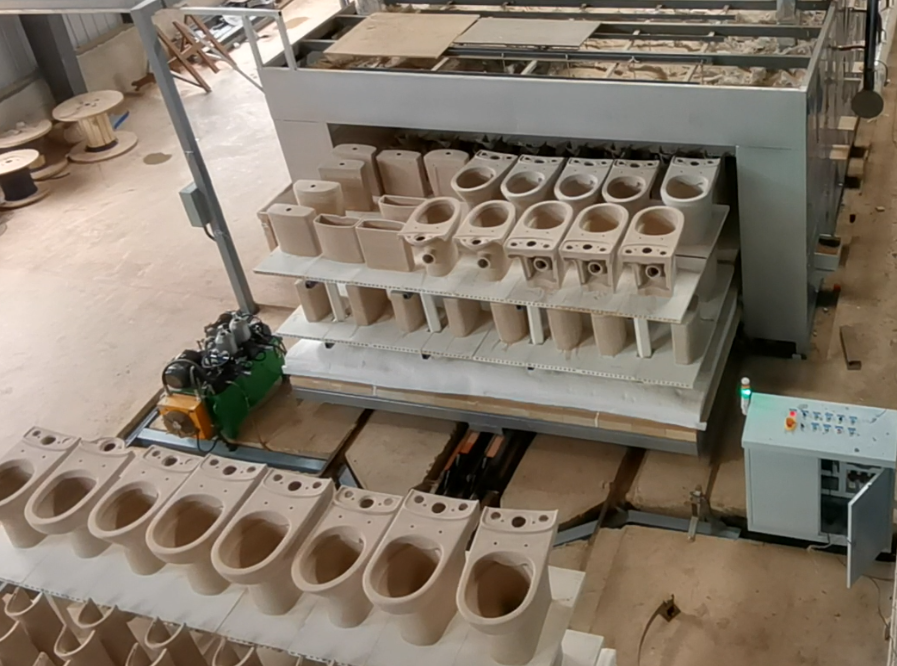 |
Loading decisions must also protect temperature uniformity and product quality. A fuller kiln is not more efficient if restricted flow or poor support increases deformation and scrap.
Sanitary ware thermal-engineering research shows that exhaust and cooling heat can serve lower-temperature demands such as drying or air preheating. Waste heat creates a saving only when it replaces energy that would otherwise be purchased.
The project must match source temperature and timing with demand, quantify exchange and transfer losses, and define backup operation during variation or shutdown. Published saving percentages depend on a particular factory model and configuration and should not be promised for another line without field measurement.
Heat recovery also needs stable production planning or suitable storage when the receiving process is unavailable.
ISO 50001 emphasizes energy baselines, energy-performance indicators and continual improvement. A plant can meter kilns, dryers, mills, compressed air and automated lines separately, then relate consumption to qualified output, product mix, running time and yield.
Lower total energy caused only by lower production is not an efficiency improvement when energy per qualified product rises. Conversely, a small fuel increase may still improve specific energy when qualified output grows by more. Quality and energy must use the same calculation boundary.
Automation should also carry an energy indicator. Oversized drives, long standby periods, compressed-air leakage and empty conveyors can add electricity even when direct labor falls.
Cost reduction is not achieved by deleting people from a cost sheet. It comes from removing waiting, variation, idle operation, heat loss and scrap. Automation can stabilize the process, while efficient kilns and heat recovery improve energy performance. When the result is verified against qualified output, a factory can lower unit cost without sacrificing quality or manufacturing capability.